The newly launched Malta Files initiative is exclusively publishing one of the studies commissioned by the Malta Film Commission on Malta’s cash rebate for film productions.
Highlights:
- This study is dated December 2021 and was conducted by Sagalytics (Dr Vincent Marmara’s company)
- Malta Files obtained the study from the Malta Film Commission. Segments of the report containing financial details were redacted by the Commission
- …but we got some more information anyway
- According to the Times of Malta Clayton Bartolo and Johann Grech said economists found that in 2022, the Maltese economy gained €3 euro for every €1 spent in cash rebates for film productions. The study being published today is dated December 2021. So we expect that these are 2 different studies.
- We’re publishing this first document to ensure that everyone is treated fairly – both the citizens of Malta who fund such schemes through their taxes as well as the movie companies and their employees
Study summary:
The cash rebate scheme was revised in 2019, increasing the reimbursement rate for eligible expenditure from 27% to 40%.
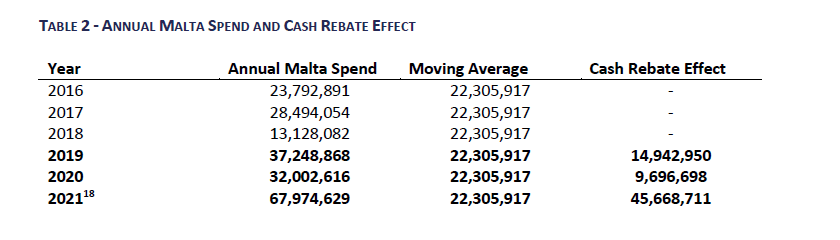
Additional spending in Malta was around €14.9 million in 2019, €9.7 million in 2020, and €45.6 million in 2021.
The majority of the spending money went into the health servicing industry (because of the covid pandemic), the retail & wholesale sector, and the accommodation & food services industry.
The study estimates that the cash rebate revision has provided a total economic contribution (including indirect and induced effects) of € 25.5 million in 2019, €16.5 million in 2020, and €77.9 million in 2021 supposedly contributing to a total increase of c. €120 million solely due to the case rebate increase over a three-year period.
The rebate supposedly supported the the full-time equivalent (FTE) of around 430 (2019), 283 (2020) and 1341 (2021) jobs. The estimated tax contribution is €28.4 million over these 3 years.
It is said that Malta positioned itself as a top Mediterranean film location attracting productions “such as ‘Troy’, ‘Gladiators’, ‘Popeye’, ‘Munich’ and more recently ‘Captain Philips’ ranking over a billion euro in combined world-wide box office receipts alone.”
The frequency of international filming in Malta has increased more than tenfold over the past 20 years “substantially propelled by the introduction of a series of cash rebates by the Malta Film Commission.”
According to the NSO, between 2018 and 2020 there was a 43% increase in employment statistics within the local film sector.
Malta strengths: English as an official language, EU membership, connectivity to Europe, 40% cash rebate.
Malta weaknesses: Lack of supporting infrastructure (e.g. production offices), the scale of the local workforce, limited resource companies.
Comparing cash rebates as at 2021: Malta 40-50%, Croatia 25-30%, Greece 40%.
A 2020 Saffrey Champness study concluded with a recommendation that Malta should implement a hybrid ATL cap of either a €1 million cap or 30% of total Malta spend (whichever higher) to deliver the highest net economic benefit for Malta, estimated at around €502,333.
“As of January 2019, qualifying audio-visual companies could receive up to a maximum of 40% in cash rebates for film production in Malta, a 13% increase in funding on eligible costs, with ATL labour costs capped at €500,000, considered to be one of the highest and thus most advantageous financial incentive in Europe.”
Eligibility was extended to those production companies having a minimum spend in Malta of €100,000 and a total budget exceeding €200,000.
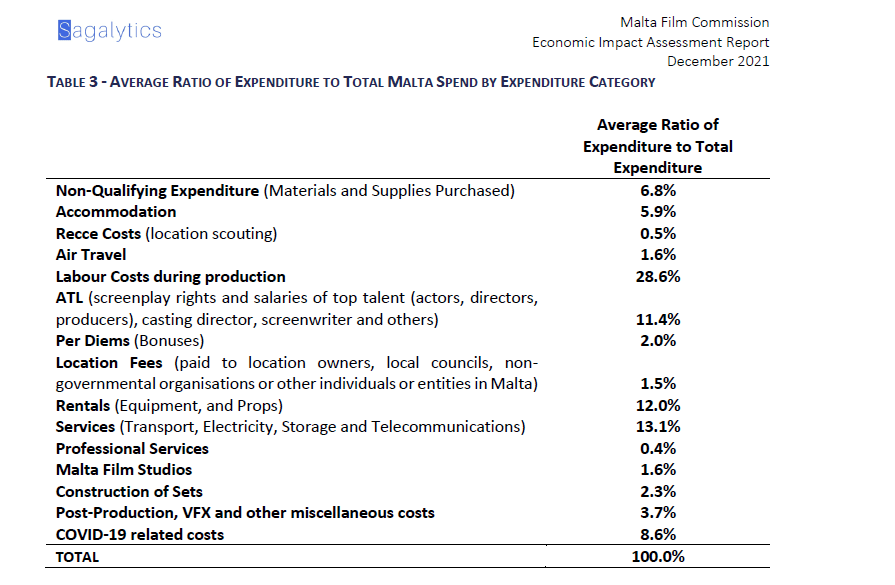
Eligible expenditure included costs related to accomodation, air travel, recce costs (reconnaissance costs), labour costs (including fringe benefits), daily allownances, location fees, rentals, services, construction, Malta Film Studios, entertainment for cast and crew (max €4000), post-production done in Malta, and “Miscellaneous Services Procured in Malta”.
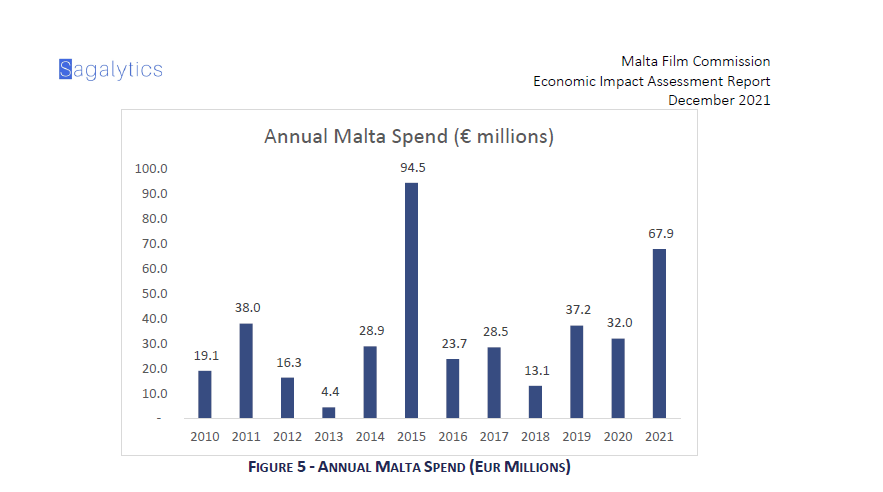
According to a 2020 Saffrey Champness study 116 productions generated a total Malta spend on €321,166,163 between 2010 and 2019, of which €218,356,507 were “Malta elements”. These included 57 features films, 20 TV Series, 8 Documentaries, 15 TV Films, 4 TV Series factual and 12 VFX productions.
According to a 2020 Saffrey Champness study, the estimated tax impact of film and TV production in Malta a total of 0.404 per €1 Malta spend.
The 2021 Sagalytics study says that its analysis represents a fair representation of the total economic contributions but does not capture each and every factor. Some impacts were excluded due to a lack of information and/or an inability to accurately quantify this impact.
Copy of the study:
 Malta Files